 Ultimate guide
The Wedding Venue Hidden Cost Checklist for Couples
Last Updated: November 16, 2026
Quick Summary
A wedding venue hidden cost checklist is a single document that forces every fee into the open before you commit, covering twelve categories such as service charges, administrative fees, mandatory gratuity, overtime, vendor buyouts, corkage, rentals, and tax. Ask for every fee in writing before you sign, because most are negotiable and all are predictable once you know what to ask.
- A complete hidden cost checklist covers twelve fee categories, and the first three are the most expensive and easiest to miss.
- Ask whether gratuity is calculated on the pre-service-charge subtotal or the post-service-charge subtotal, because stacking compounds the cost.
- A usable checklist template has five columns: fee name, whether it applies, disclosed amount, negotiability, and contract page.
- Request a redacted sample invoice from a past event, the most useful and least requested item on the checklist.
- Negotiate before signature, starting with policy fees like administrative, cake cutting, and corkage, which are easiest to waive.
Table of Contents
- Why Venue Fees Catch Couples Off Guard
- The Wedding Venue Hidden Cost Checklist: 12 Fees to Find
- Hidden Wedding Costs Beyond the Venue: Rentals, Linens, and Tax
- Your Wedding Venue Hidden Cost Checklist Template
- How to Use a Free Printable Wedding Venue Checklist
- Building a Wedding Budget Estimator That Includes Extras
- Negotiating Venue Fees Before You Sign the Contract
- The Preferred Vendor Trap and Post-Event Billing Disputes
- Ask the Venue: A Script for Your Walkthrough
- Book Your Walkthrough at Five Oaks Farm
- Frequently Asked Questions
Why Venue Fees Catch Couples Off Guard
The quote a venue gives you at the first tour is often not the number you pay at the final invoice. That gap is the most common budget surprise in wedding planning, and it traces back to line items disclosed in the contract but never explained in plain language. The fix is always the same: ask for every fee in writing before you sign.
The problem is structural. A venue's advertised rate is a base rate, and your total is that base plus service charges, rentals, taxes, gratuity, and conditional fees that trigger only if you bring an outside vendor, run late, or need something the venue does not stock.
The wedding venue hidden cost checklist closes that gap. It is a single document that forces every fee into the open before you commit. Most of these fees are negotiable, and all of them are predictable once you know what to ask.
The Wedding Venue Hidden Cost Checklist: 12 Fees to Find
A complete hidden cost checklist covers twelve categories, each falling into a specific part of your contract. The first three are the most expensive and the easiest to miss.
Service Charges, Administrative Fees, and Mandatory Gratuity
A service charge is a percentage added to your food and beverage total, typically to cover staff and operations. An administrative fee is a separate charge for paperwork, coordination, or facility overhead. Mandatory gratuity is a tip charge written into a venue contract rather than left to your discretion.
The trap is stacking. Some contracts apply a service charge and then a gratuity on top of the post-service-charge total, which compounds the cost. Ask directly: "Is the gratuity calculated on the pre-service-charge subtotal or the post-service-charge subtotal?"
Overtime, Late-Night Extensions, and Power Fees
Venue contracts often specify a rental window, and time past it may carry an overtime charge. Late-night extensions are usually billed hourly and sometimes require additional security or staff. Power and lighting fees appear when your event needs more electrical capacity than the base package includes, which is common for bands, lighting designers, and large catering setups.
Ask for the overtime rate in writing and confirm when the clock starts, some venues bill from the contracted end time, others when the last guest leaves.
Vendor Restrictions, Buyouts, and Corkage
Caterer restrictions are where budgets quietly break. A venue may require its in-house catering or a preferred vendor list, and an outside caterer may trigger a vendor buyout fee or a kitchen-use charge. If you want to bring your own alcohol, expect a corkage fee per bottle, and if you bring your own cake, a cake cutting fee per slice or per cake.
None of these are unreasonable on their own. The mistake is assuming "outside vendors welcome" means "outside vendors welcome at no extra cost."
Hidden Wedding Costs Beyond the Venue: Rentals, Linens, and Tax
The venue fee is only one line in the budget. Rental equipment, linens, tables, chairs, flatware, and lighting often sit outside the base package, and renting them separately can rival the venue fee itself.
Tax deserves its own line. The rate depends on jurisdiction and on which items are taxable, food, alcohol, and rentals are sometimes taxed differently. Confirm the rate in writing and ask which line items it applies to.
Setup and teardown, cleaning fees, security deposits, and damage waivers round out this category. A damage waiver is not insurance; it is a non-refundable fee that limits your liability. For a fuller picture of how venue pricing and package inclusions compare, see our guide to affordable rustic wedding venues in Texas.
Your Wedding Venue Hidden Cost Checklist Template
A usable wedding venue hidden cost checklist template has five columns: fee name, whether it applies to your event, the disclosed amount, whether it is negotiable, and the contract page where it appears. Fill in every row before you sign.
| Fee Category | Applies to Your Event? | Disclosed Amount | Negotiable? | Contract Page |
|---|---|---|---|---|
| Service charge | Yes / No / Unknown | $____ or __% | Often | ___ |
| Administrative fee | Yes / No / Unknown | $____ | Sometimes | ___ |
| Mandatory gratuity | Yes / No / Unknown | __% | Rarely | ___ |
| Overtime / extension | Yes / No / Unknown | $____ per hour | Sometimes | ___ |
| Power and lighting | Yes / No / Unknown | $____ | Sometimes | ___ |
| Vendor buyout / corkage | Yes / No / Unknown | $____ | Often | ___ |
| Cake cutting fee | Yes / No / Unknown | $____ | Sometimes | ___ |
| Rentals and linens | Yes / No / Unknown | $____ | Often | ___ |
| Cleaning fee | Yes / No / Unknown | $____ | Rarely | ___ |
| Security deposit | Yes / No / Unknown | $____ | Rarely | ___ |
| Damage waiver | Yes / No / Unknown | $____ | Rarely | ___ |
| Tax rate applied | Yes / No / Unknown | __% | No | ___ |
Any row you cannot fill in is a question for the venue, not a blank to leave open. A fee listed as "to be determined" or "subject to change" gives the venue room to raise it after you sign, so push for a fixed number or a written cap.
How to Use a Free Printable Wedding Venue Checklist
A free printable wedding venue checklist works best when you bring it to the tour, not after it. Print one copy per venue and fill it in on site while the coordinator is in front of you.
Work through it in this order:
- Ask for the full fee schedule in writing before the tour ends
- Confirm which fees are flat and which are percentages
- Mark every fee that only applies if you use an outside vendor
- Ask what triggers overtime billing and when the clock starts
- Confirm the tax rate and which line items it applies to
- Ask for the deposit, cancellation, and refund terms in writing
- Request a sample final invoice from a past event with names removed
That last item is the most useful and the least requested. A redacted sample invoice shows exactly how the fees stack in practice. If a venue will not produce one, treat that as information too.
Building a Wedding Budget Estimator That Includes Extras
A wedding budget estimator is only as good as the fees you feed into it. Most couples build their estimate from the venue quote plus catering plus photography, then discover the extras after the fact. Build it the other way: start with the total you can spend, subtract the known fixed costs, and reserve a contingency line for the fees on your checklist.
A workable structure looks like this:
- Total budget, fixed
- Venue base fee, from the contract
- Service charge and administrative fee, calculated as a percentage of the catering estimate
- Mandatory gratuity, calculated on the correct subtotal
- Rentals and linens not included in the package
- Tax, applied at the confirmed rate
- Contingency, held back for overtime, corkage, and conditional fees
That contingency line is not padding. It absorbs the fees you flagged as "may apply" on your checklist. Couples who build it in tend to stay inside their budget; couples who skip it tend to renegotiate with themselves in the final weeks.
Negotiating Venue Fees Before You Sign the Contract
Most venue fees are negotiable, but only before signature. After the contract is executed, you have very little leverage, because the venue has your deposit and the terms are fixed. The strongest negotiating position is a couple with a written checklist, a competing quote from another venue, and a genuine willingness to walk away.
Then ask for inclusions instead of discounts. A venue that will not reduce the base fee may include linens, an extra hour of rental time, setup and teardown, or a waived cake cutting fee, worth as much as a discount while costing the venue less to give.
The contract language is where negotiation is won or lost. Three clauses deserve close reading before you sign:
- "Subject to change" and "to be determined" language. A fee listed as TBD or subject to change gives the venue room to raise it after you sign. Push for a fixed number or a written cap, and ask what triggers a change.
- The overtime and extension clause. Confirm the hourly rate, when billing starts, and whether additional staff or security charges attach to an extension. Get the start trigger in writing.
- The cancellation and force majeure clause. Ask what portion of your deposit is refundable at 12 months, 6 months, and 30 days out, and what happens if the venue itself cannot perform. The refund schedule is a negotiable term, not a fixed one.
Get every concession in writing as a contract amendment or signed addendum, not a verbal promise. A coordinator's assurance that a fee "probably won't apply" is not enforceable. If the venue will not amend the contract, ask for a confirming email that restates the concession and keep it with the signed agreement.
Watch out: a deposit is usually non-refundable once paid, so do not put money down to "hold the date" while negotiation is still open. Before you begin this conversation, it helps to understand the full booking sequence and what the contract commits you to, which our modern farmhouse venue booking guide walks through step by step.
The Preferred Vendor Trap and Post-Event Billing Disputes
A preferred vendor list is exactly what it sounds like: a set of vendors the venue recommends. What most couples never learn is how that list is built.
Ask two questions before you accept any recommendation: "Is this vendor required or recommended?" and "Does the venue receive any payment, commission, or discount from this vendor?" A coordinator who answers both directly is giving you useful information. A coordinator who deflects on the second question is telling you something too.
The financial mechanics matter because they change what "preferred" means in practice. A venue that earns a referral fee has a reason to steer you toward its list even when an outside vendor would cost you less.
Post-event billing disputes almost always trace to one of four sources: overtime that started earlier than expected, damage charges assessed after the event, gratuity calculated on a different subtotal than assumed, or a fee that appeared on the final invoice but was never in the signed contract. Each is preventable, but only if you build the record before the event rather than after.
A workable prevention sequence looks like this:
- Document the pre-event walkthrough. Walk the space with the coordinator a week or two before the wedding, note existing damage in writing or photos, and confirm the contracted start and end times in the same conversation.
- Confirm the overtime trigger in writing. Ask whether billing starts at the contracted end time or when the last guest leaves, and get the answer by email.
- Get the final invoice itemized. Request a line-by-line invoice before payment is due, not a single total, and compare each line to the contract page that authorizes it.
- Pay by traceable method and keep the paper trail. A credit card gives you a dispute process that a check or cash does not.
If a charge appears that was not in the contract, request the specific clause that authorizes it in writing. If they cannot produce it, put your objection in writing before you pay the disputed portion, pay the undisputed balance to avoid late fees, and keep the correspondence.
Watch out: a coordinator's verbal assurance that a fee "probably won't apply" is not enforceable. Get every concession and clarification in writing, and treat the signed contract as the only document that controls what you owe.
Ask the Venue: A Script for Your Walkthrough
The most efficient way to surface hidden fees is to ask about them directly, in the same order every time, at every venue you visit. Here is the script we suggest couples bring to a walkthrough.

"Can you walk me through every fee that appears on the final invoice, not just the base rental?
Then follow up with three questions that most couples never ask:
- "Which of these fees are negotiable, and which are fixed policy?"
- "What is the process if we dispute a charge after the event?"
- "What is the deadline for changes, and what happens if we add guests after it?"
Write the answers down in front of the coordinator. It signals that you are organized and that you intend to hold the contract to its terms, which tends to produce more careful answers. If you want the venue's own answers on vendors, catering, alcohol, rentals, and timing before you arrive, our wedding FAQ covers those questions directly.
Book Your Walkthrough at Five Oaks Farm
The best way to test a venue's fee transparency is to ask for the numbers in person and watch how the answer is delivered. A venue that hands you a complete fee schedule without being pushed is one that is being open with you.
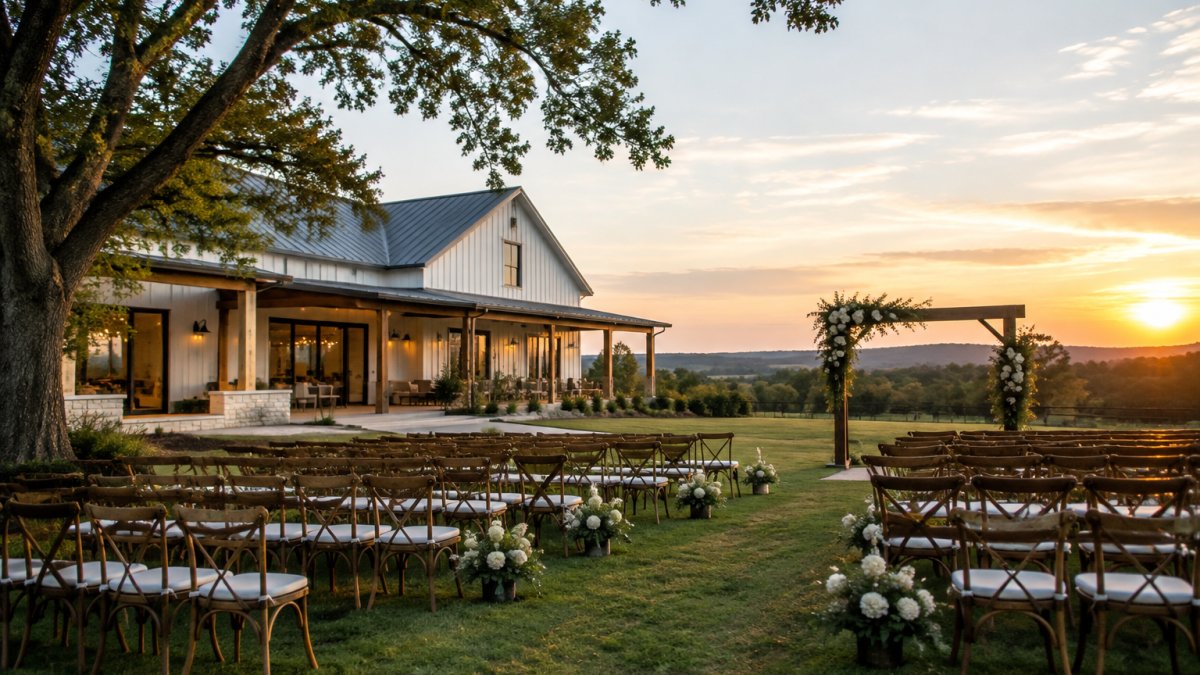
Five Oaks Farm is a modern farmhouse-inspired venue with a Hill Country feel, set among mature oak trees and open countryside, with both indoor and outdoor spaces. We welcome couples and milestone celebrations from the Fort Worth and DFW area, and you are welcome to ask us about pricing and details before you commit. Current pricing is available on our website. Explore Five Oaks Farm Wedding Packages to see the actual package pricing and inclusions.
The difference between a wedding budget that holds and one that unravels is almost never the venue fee itself. It is whether you asked about the twelve fees around it before you signed. Five Oaks Farm offers modern farmhouse indoor and outdoor spaces, mature oak trees and countryside views. Schedule a tour and bring your checklist.
Frequently Asked Questions
What hidden costs should I look for when booking a wedding venue?
Focus on the line items that rarely appear in the headline rental quote: service charges and administrative fees, mandatory gratuity, overtime and late-night extension fees, vendor buyout or outside catering fees, corkage and cake-cutting fees, power and lighting charges, valet or shuttle service, cleaning and damage deposits, and applicable sales tax. Ask for a sample final invoice from a past event so you can see how these stack up. A hidden cost checklist keeps you from discovering them after you have signed.
What is usually included in a wedding venue rental fee?
Package inclusions vary, so ask what the quoted fee covers. Confirm whether it includes the ceremony and reception or charges a separate ceremony fee, and whether a day-of coordinator is part of the package. Get every inclusion written into the venue contract so nothing shifts later.
How can I compare wedding venue quotes accurately?
Build a side-by-side comparison using a wedding budget estimator that lists every fee category, not just the rental price. Ask each venue for a full budget breakdown that includes tax, gratuity, service charges, and rentals. Then compare the total for the same guest count and the same hours. A venue with a higher base fee but fewer add-ons can cost less overall than a lower quote with mandatory extras.
What should I check in a wedding venue contract before signing?
Read the sections on payment schedules, cancellation and postponement terms, overtime charges, vendor restrictions, liability insurance requirements, security deposit and damage waiver rules, and the final invoice process. Look for language that allows fees to change without notice. Ask for the preferred vendor list and any caterer restrictions in writing. If a term is unclear, request a revised clause before you sign.
Do wedding venues charge extra for setup and cleanup?
Ask whether setup and teardown are included in the rental fee or billed separately. Confirm who handles tables, chairs, linens, and trash removal, and whether a cleaning fee applies. Ask what time access begins and when everything must be cleared out, because early access or late pickup can trigger overtime charges.
How much should I budget for wedding venue extras?
Plan a cushion for extras such as rentals, lighting, power, valet, and service charges. The exact amount depends on your guest count and how much the venue includes. Use a wedding budget estimator to model a low, mid, and high scenario, then confirm each assumption with the venue in writing so your final invoice holds no surprises.